

Supreme Court Secretariat Ordinance Sparks Debate Over Judicial Powers
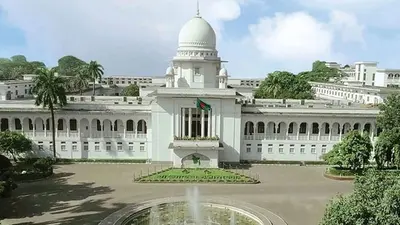
The Supreme Court Secretariat Ordinance, 2025, intended to ensure financial and administrative independence of the judiciary, has emerged as a politically sensitive issue as a parliamentary committee examines its key provisions, particularly those related to authority over subordinate court judges.
During its last two meetings, the Ministry of Law, Justice and Parliamentary Affairs informed the 12-member parliamentary special committee that the ordinance places control over subordinate court judges and judicial budgeting under the Chief Justice through the secretariat.
The ministry raised concerns that concentrating these powers could be risky.
According to the ministry, the current system — in which the Supreme Court decides on government proposals regarding the transfer, promotion, and discipline of the subordinate court judges — reduces the chance of absolute control by a single individual and ensures checks and balances between the executive and the judiciary, several members of the committee confirmed to New Age.
The ministry suggested scrapping Article 7 of the ordinance to address this issue, which covers these powers and amending related provisions, including Article 5, to maintain a balance.
Another option under discussion is to keep Article 7 but to make it effective only through a government gazette notification in consultation with the Supreme Court, if the government ‘deemed it appropriate’.
Despite differences, the ministry favoured the passage of the ordinance with amendments to ensure judicial financial autonomy while addressing concerns over the concentration of powers.
The 12-member special parliamentary committee, headed by Zainul Abedin, MP is reviewing 133 ordinances promulgated during the interim government’s tenure under Article 93(1) of the constitution, with its report expected by April 2.
The committee scrutinised the validity of 115 ordinances, while 18 — including the one related to the Supreme Court Secretariat — remain under consideration.
The committee will sit again at about 8:30pm today to discussion the issues.
The Supreme Court Secretariat Ordinance, 2025, introduced to ensure financial and administrative autonomy of the judiciary, has emerged as a politically sensitive issue.
The law, justice and parliamentary affairs ministry argued before the committee that the ordinance vested control over the subordinate court judges and judicial budgeting with the chief justice via the secretariat.
However, the ministry has raised concerns over the concentration of authorities.
The existing mechanism, it said, reduces the risk of any single individual exercising absolute control over subordinate court judges. It also opined that the ordinance would ensure no coordination between the work of the government and the judiciary.
It also discussed an alternative approach—retaining Article 7 but making its implementation conditional.
Under this proposal, the government, in consultation with the Supreme Court, could activate the provision through a gazette notification if ‘deemed appropriate’.
Retired district judge Md Masder Hossain, a key figure in the movement for separation of the judiciary since the 1990s, criticised the law ministry’s stance on the ordinance.
He warned that his long struggle for full judicial separation would be undermined if the ministry’s position was reflected in the law.
He questioned the rationale of separation if the control over the transfer, promotion and discipline of subordinate court judges remained with the executive.
‘The judiciary should be led by the chief justice. Why should the law ministry supervise it?’ he said.
He added that it took 55 years to move towards separating the judiciary, a principle envisioned by the framers of the constitution after the Independence War.
Committee member AM Mahbub Uddin (Khokon), MP told New Age that he, as a SC lawyer and president of the SC Bar Association, supported ratifying the ordinance to ensure full judicial independence.
Lawyer Mohammad Shishir Manir told New Age that the government’s current move could amount to contempt of court and further curtail the independence of the judiciary.
Committee chairman Zainul Abedin, MP declined to comment on whether the law ministry had objected to ratifying the Supreme Court Secretariat Ordinance, saying, ‘It is a confidential matter.’
He told New Age that both the Supreme Court Judges Appointment Ordinance and the Supreme Court Secretariat Ordinance were among the 24 ordinances kept for further discussion.
The Supreme Court Secretariat has secured financial autonomy and is nearing full operation since December 11, 2025, currently staffed with 15 judicial officers and 19 support staff, with a permanent office expected within 15–20 days, the secretary Sk. Ashfaqur Rahman said.
While handling most administrative functions, the secretariat will implement provisions under Clause 7 of the ordinance—including posting, promotion, and discipline of judges—once ratified by the government.
The law, justice and parliamentary affairs minister Md Asaduzzaman said that no decision had been taken yet, as the matter was still under discussion.
He said that the government reaffirmed that the judiciary is independent and said it will take all necessary steps to uphold judicial independence.
Source: New Age