

Law Society of England and Wales Expresses Concern Over Bangladesh Bar Election Irregularities
Following allegations of obstruction to candidacies and various irregularities in bar association elections across different districts of Bangladesh and the Supreme Court Bar Association, the Law Society of England and Wales has expressed concern in a letter addressed to Prime Minister Tarique Rahman of Bangladesh.
Earlier, the Council of Bars and Law Societies of Europe (CCBE), Europe’s leading legal representative body, had also sent a similar letter expressing concern.
The letter, signed by Mark Evans, President of the Law Society, which represents more than 200,000 solicitors in England and Wales, was sent last Wednesday.
In the letter, the organization called for high-level intervention and necessary measures by the Government of Bangladesh to ensure the independence, security, and self-governance of the legal profession.
The matter of sending the letter was officially confirmed by Andrea Schweitzer, Junior Press Officer of the Law Society.
In a written statement, she said, “I confirm that this letter is authentic and was officially issued on behalf of the Law Society.”
She declined to comment further on the matter.
The Supreme Court Bar Association elections were held on Wednesday and Thursday. Out of 11,097 registered voters, 4,048 votes were cast over the two days, resulting in a voter turnout of 36.48 percent.
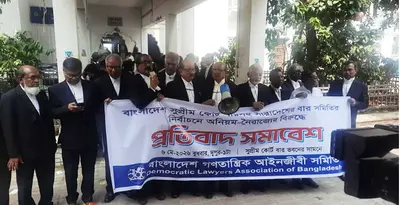
In the Supreme Court Bar Association election, the nominations of nearly 40 candidates were canceled. Allegations were raised that candidates affiliated with the Awami League and several of its affiliated organizations, against whom activities are reportedly restricted, were disqualified.
Referring to various reports published between February and April, the Law Society stated in its letter to the Prime Minister that “unprecedented interference” had taken place in Bangladesh’s bar elections.
The organization stated, “Many lawyers affiliated with the Bangladesh Awami League and independent candidates were prevented from participating in the elections, obstructed from submitting nomination papers, and in some cases subjected to physical harassment.”
The organization further alleged, “In certain instances, nomination papers were formally rejected on the grounds that the candidates were allegedly ‘associates of fascists.’ Additionally, reports suggest that police intervened to pressure some candidates into withdrawing their nominations or prevented them from participating in the elections by labeling them as collaborators of the previous government.”
The organization reminded the Prime Minister that such actions are entirely “inconsistent” with Principles 16, 17, 18, and 23 of the United Nations Basic Principles on the Role of Lawyers.
Referring to Principle 16, the letter stated, “Preventing lawyers from submitting nomination papers, arbitrarily canceling their candidacies, or pressuring them to withdraw directly undermines this principle. Such actions indicate improper interference in the self-governance of the legal profession.”
The organization also stated that the alleged involvement of police in pressuring candidates could further endanger the affected individuals and is contrary to Principle 17.
Criticizing the political labeling of lawyers, the letter said, “Reports describing candidates as ‘associates’ or ‘collaborators’ are contrary to Principle 18, as they politicize the identity of lawyers and expose them to punishment based on perceived political affiliation rather than professional conduct.”
The Law Society described these incidents of interference in bar elections as a clear “pattern” aimed at undermining the independence of the legal profession and weakening the rule of law.
At the conclusion of the letter, the organization presented three specific demands to the appropriate authorities in Bangladesh:
• Ensure that bar association elections are conducted with equal participation opportunities for all lawyers without discrimination.
• Conduct impartial investigations into allegations of electoral irregularities, obstruction, harassment, or violence in all concerned bar associations.
• Ensure that all lawyers can perform their professional duties without fear of retaliation, obstruction, or intimidation in order to uphold the independence of the judiciary.
Copies of the letter were also sent to the Bangladeshi High Commissioner in the United Kingdom, the British High Commissioner in Dhaka, Bangladesh’s Permanent Mission to the United Nations Office in Geneva, and the United Nations Special Rapporteur on the Independence of Judges and Lawyers.
Earlier, on April 30, the Council of Bars and Law Societies of Europe (CCBE) had also sent a letter to Prime Minister Tarique Rahman calling for an end to “irregular and undemocratic” practices in bar elections.
Citing information provided by the France-based organization JusticeMakers Bangladesh in France (JMBF), CCBE President Roman Završek stated in the letter that an extremely undemocratic environment had prevailed during several district bar and Supreme Court Bar Association elections held between February and April.
The CCBE letter also alleged that Awami League-backed lawyers and independent candidates were prevented from participating in the elections, obstructed from submitting nominations, and physically harassed. It further claimed that many candidates were disqualified by being labeled as collaborators of the previous government or “associates of fascists,” while police directly pressured candidates to withdraw their nominations.
Like the Law Society, the CCBE also urged the Government of Bangladesh to ensure non-discriminatory participation, conduct fair investigations, and create an environment where lawyers can perform their professional duties independently. Referring to Articles 16, 17, 18, and 23 of the United Nations principles, the organization additionally called on Bangladesh to sign and ratify the new Council of Europe Convention on the Protection of the Profession of Lawyer.